99designs - Connecting Designers from Around the World

Vishal Sharma Tuesday, July 15, 2008 , , , , , , , , , , , 0 comments

Today we showcase an exciting and a successful venture co-founded by, Mark Harbottle in 2008 from Melbourne, Australia, 99designs - it connects thousand of designers from around the world with clients who need design tasks completed fast, and without the usual high cost and limited choice you get from most traditional design firms.

In a recent email based interview with Mark, he gave insights into his venture and how he is progressing with it. This is what he has to say:

• Please tell us about yourself, your background and interests?
I’m 34 years old. I have a degree in computer systems engineering. I started my working life as a programmer, but I eventually found I was much better at online marketing, which back in 1995 was an area not many people had explored.
I’ve worked with pure internet businesses for 13 years now. The first 4 years after I graduated I worked with one of Australia’s first internet companies, and the last 9 have been spent working on my own businesses. I started sitepoint in 1999 with a business partner in Canada, and I launched a new company earlier this year called 99designs.
I live in Melbourne with my wife and two little girls. When I’m not running around after two kids and two businesses (I’m not sure which is harder) I’ve usually either escaped to the footy or I’m at the gym battling to keep fit.

• What services do you provide for your customers?
99designs can be used to source any custom design work, so logo designs, business cards, web page designs, brochures, t-shirts, banner ads and so on. The difference between 99designs and your typical design firm is that we have access to a large community of designers who contribute to the outcome of your design rather than a single person.
The way it works is like this…
Say you want a logo designed for your business - you post your requirements on 99designs.com for $39 USD and nominate the amount you wish to pay for the finished design, say $300 USD. Designers from around the world view your requirements and start producing designs for you. Over the course of a few days you guide the designers by communicating what you like and dislike about their work. At the end of the process you choose your favourite design, pay the designer the amount you nominated (in this case $300 USD), and you walk away with a finished design.
We currently have around 16,000 registered designers, growing at 100 a day, so there’s no shortage of creative inspiration and variety.

• Who are the people behind this and how did it get started?
The original concept that 99designs is based on was founded by a group of passionate designers within the sitepoint.com forums. These particular designers needed an outlet for their work and they loved challenging each other so they would seek out small design projects and compete to produce the best design.
We noticed that this activity was gaining in popularity within the forums so we invested in building an online platform to better manage the design process and help bring new projects to the table for the designers. We ran a proof of concept for 18 months before deciding that it had enough legs to spin off into a new company.
So you could say our users founded the idea, we just crafted it into a business.

• What is the main objective/mission behind your venture?
Our objective is to build the biggest designer community on earth. The designers really are the core of our business, so our goal is to provide them with a friendly, professional, and secure environment where they can compete on a level playing field, show off their work, improve their skills, communicate with peers, and build relationships with new clients. We already have many designers from around the world who make their living through 99designs.com.

• What type of customers you are targeting?
As I mentioned 99designs is a community of designers but when business is transacted it’s also an online marketplace, and like every marketplace you have two sides to target – buyers and the sellers. For 99designs, the buyers are the clients seeking design work, and the sellers are the designers selling their services - so we obviously need to cater to both.

• How many people are using your services?
In the 4 months since we launched 99designs has grown to over 35,000 registered users, around half are designers. Traffic has grown from just 1.5 million page views per month in February 2008 to over 6.2 million page views a month in July 2008. It really is going gang busters.

• What sort of marketing you are using to spread the word?
Apart from ad hoc promotions on our sister site (sitepoint.com) we haven’t done any outbound marketing at all – the uniqueness and simplicity of the service we provide and the fact that we’ve disrupting the multi-billion dollar a year design industry has meant that word of mouth has largely been responsible for our growth to date.

• How are you measuring the success of your venture? Are their any special mechanisms/tools in place to monitor the progress?
Yes, we measure the success of our venture based on a number of key metrics. We have an online dashboard that’s linked to our user database via a number of reports and graphs that provide an instant view of everything that’s going on in the business. We also use third parties tools like Google Analytics to measure traffic and track referrals.

• What is the monetizing/revenue model? Is their any new model, which is being tried?
We charge a $39 USD listing fee to upload your design brief to 99designs.com. That gives you access to our design community who will view your brief and decide if they want to participate. The designer is paid directly by the customer once they produce a design they’re happy with. That’s the way it works now, but we’re moving towards a slightly different model where we charge a small success fee at the end of the process and handle the whole transaction. This will simplify things a lot for everyone.

• Which are the main competitors or major players in this market segment?
There are a few competitors popping up and drawing inspiration from 99designs, however by being first to market we’ve very quickly established a critical mass of both designers and clients and claimed the #1 spot in this space. Obviously we’re working hard to protect our position and continue to grow.

• What are the main technologies used behind this venture?
99designs is built using commodity open source tools, Apache, PHP and MySQL. The site is hosted on Amazon's virtualized clustering product, EC2. Thanks to a number of cutting edge tools, the site can scale up or down virtual server resources based on time of day and traffic demands. This has allowed 99designs to survive a sustained growth that would have outgrown conventional setups several times.

• What is your operating environment (operating system) and what type of database you are using?
The development and production servers run Linux. The database servers run MySQL 5 with Innodb.

• The conventional computing model is shifting to Cloud computing. How do you see the future of business changing with the use of this technology?
I see the major change being the lower barrier for entry for small startups. Garage-based companies can now develop applications in weeks that can handle huge volumes of traffic and only pay for what they use. Avoiding significant infrastructure costs up front means less risk, and more funding for innovative ideas. The ability to scale on demand means smaller outfits can hope to deal with the volumes of traffic that sites like Digg and Facebook can deliver without having to provision entire server farms ahead of time.

• What do you think the government (federal and state) should do to improve the culture of innovation?
At a federal level they shouldn’t be removing access to key government funding initiatives such as the Commercial Ready Grant. Start ups need all the help they can get and grants such as these are vital for their survival.
In terms of encouraging established businesses to innovate I think if your company has a proven history of success there should more in the way of incentives to encourage you to do more to drive innovation, whether that be via new grants, tax offsets, or rebates.
On a state level, they should be providing incentives for businesses who hire more people not penalizing them – so abolishing payroll tax would be a good start.

• If you are given an opportunity to change the nation, what 3 things would you do?
I would improve our health care system buy looking at examples of what’s working and what’s not working overseas. I would do something about the rising cost of living and housing affordability. And lastly I would build desalination plants around the country, funded by introducing a ‘water tax’ for excess water usage. Seems logical to me.

Thanks Mark for sharing your thoughts with us. All the best for future.

For coverage on other Australian startups, innovation, tech trends check this out and our coverage on interviews can be found here

Continue Reading >>

Webdirections - Conferences for Web Professionals in Australia & North America

Vishal Sharma Saturday, June 07, 2008 , , , , 0 comments

In our ongoing coverage of startups coming out of Australia and interviews with CEO's, Media Personalities, Philanthropists, and VC’s, to gauge the innovation and startups landscape in Australia, today we showcase our interview with, the co founder of Webdirections - Conferences for web professionals held in Australia and North America, John Allsopp .

I did this interview with John to know more about Webdirections, its offerings, its progress and future plans and how his second venture Westciv is progressing. Let us explore what John has to say about the progress of Webdirections and Westciv Australia. This is what he has to say:

• Please tell us about yourself, your background and interests?
I'm a software engineer, with a computer science and maths degree, coupled with quite a few arts subjects at university, and most of a law degree.
Born and raised in Sydney, I lived for a time in the UK, and Italy in the early 1990s, before starting my first company in 1994

I live just outside Sydney, in the national park, with my wife and two young daughters, and try to take advantage of the location I live in by doing lots of outdoors stuff, to counter the hours a day in front of computers.

I've been a volunteer surf lifesaver for a decade, at Bondi Beach, I plat football (soccer) with a local team, and do quite a bit of mountain biking.

Please tell us about your venture/company/ start-up?
We have two - a well established small software company called westciv, which developers web development tools for Mac OS X and Windows, as well as a range of online tools and resources, training and so on for web developers - novice and experienced.

Our more recent venture is Web Directions, conferences for web professionals held in Australia and North America, and soon hopefully elsewhere as well.

Our big event is Web Directions South, in Sydney at the end of September each year (now in our 5th year) - at the Convention Centre - last year saw just under 650 people attend. The conference also includes an Expo of products and services relevant to web professionals

Who are the people behind this and how it started?
Both these companies are run by myself, and Maxine Sherrin.
Westciv was founded in 1994, to develop and publish a hypertext knowledge management application called Palimpsest. Marketing and distributing it online in the mid 1990s lead us to see the potential of the web as a medium for publishing and software distribution.

Web Directions was founded with two others in 2004 as Web Essentials, a grass roots style conference for web developers interested in standards and accessibility. After two years, Maxine and I continued on our own, and have turned an expensive hobby into a successful conference series that has been attended by ver 2000 people from all over the world.

How long it took before it was up and running?

  • Westciv took about 18 months from being founded to releasing our first application.
  • Web Directions launched it's first conference weeks after being formed, and held it's first conference within 5 months.

What is the main objective/mission behind your venture?
  • Westciv - to build the best web development tools and resources available
  • Web Directions - to put on the best possible conferences, mixing content, inspiration and networking for web professionals anywhwere in the world.

What market segment verticals you are targeting for?
Both our ventures target web professionals. Westciv is more focussed - on designers and developers, people who code web sites. Web Directions broadens the focus to anyone whose day to day job is building and managing web sites, applications, services and communities. That includes IA experts, UX experts, front-end back end programers, designers, developers, project and product managers, all the way to senior management.

How many people are using your services?
Westciv - the site and its resources are used by millions of people each year.
Our software is used by hundreds of thousands, and we have n the order of tens of thousands of paying customers.

What sort of marketing you are using to spread the word?
Almost entirely word of mouth and online.

How are you measuring the success of your venture? Are their any special mechanisms/tools are in place to monitor the progress?
Food on table. But seriously, our metrics are quite informal - attendance growth at conferences, inbound linking to sites, buzz on networks like twitter, number of photos on Flickr, software sales .

What is the monetizing/revenue model? Is their any new model, which is being tried?
Pretty straightforward model for each - folks buy our software or premium content, or pay to attend our conferences. Sponsorship and the Expo at the conference account for a reasonable amount of our revenue, but our aim there is to work with sponsors to put on a better conference - better wifi network, better social experience, and so on.

In fact, this model for Web Directions is probably a bit less obvious than it appears. Many conferences see Expos and sponsorship as a primary revenue source, and so their number one customers are sponsors. In our case, the event has always been put on by us as members of the professional community, and so our attendees come first.

Which are the main competitors or major players in this market segment?
Software- there are a number of smaller software companies building tools that directly or indirectly compete with ours on the Mac and Windows - none that target both platforms. The applications like Dreamweaver from large software companies are no so much competitors, as our software compliments their functionality rather than going head to head with it.

In the conference space, around the world there are a number of conferences focussing on a similar niche - but these tend to have a slightly different focus, or a slightly narrower focus.
In Australia, there really is nothing like Web Directions in the web professional space.

How do you see Webdirections in future and what can we learn from it?
Conferences are resource intensive, and require a reasonable amount of startup capital, though this can be returned quite quickly with a successful event.
Conferences tend to be put together by conference companies, which service a perceived need in an industry. Our motivation was and remains quite different. We felt the lack of an event in the professional community we were members of. It's primarily driven by our passion and desire to see the Australian web industry grow and prosper, and take on the world, and while we carefully mange it as a business, we definitely spend money and effort where others would see that as a waste.

We hope Web Directions will move from being just a conference to a real hub for the community of web professionals here and world wide - through events, publications, and other activities.
What did we learn that we'd pass on to others. Temper passion with realism. Have a long term plan (our conferences effectively lost money for several years before becoming financially really viable if you look at the opportunity cost). But passion and commitment to things you care about go a long way, even when up against multinational companies, and large established players.

What are the main technologies used behind this start-up?
For web directions, we've used a lot of open source, web based software as a platform for building our own solutions incrementally. Our sites are run on top of Wordpress - which enables us to quickly roll out new events once they are planned.
We've also built a fantastic registrations management system using ruby on rails that means we can get new events up and running online in hours or less. It manages payments via just about any gateway, affiliate programs, promotional offers, and all the registration management stuff we've found we need to run the conference. We can even print our badges more or less directly out of it.

What has been the most easy to use, out of box and helpful technology?
Not a lot of out of the box stuff - though we have been thinking of turning our registration system into an out of the box service for other events - big and small.

Are you using lot of open source tool sets for this?
Yes - All LAMP stacks or Rails on top of open source OS's on commodity hardware.

What is your operating environment (operating system) and what type of database you are using?
Server side it's apache and MySQL - on top of either BSD or Linux. Client side we are mostly Mac, but windows to an extent too - but most of our management etc is browser based, so clients are less of an issue.

How often do you catch up with others trying similar things and where do you catch up? Do you have dedicated communities in your city?
Rarely. We tend to meet up with a few folks holding events like ours either at our own events here and Canada, or when speaking at events elsewhere. In terms of software, there's little client app development happening in Australia - we know about 4 in the Mac space we'd say are similar to us ()there's probably quite a few more out there, but we have nothing like the networks you find in the US.

What’s your thought on being an entrepreneur? How tough it is to start a venture in Australia?
Very. Above all because we don't have the kinds of networks and culture you can find in San Francsico and the valley, Austin, Seattle, New York, and a number of other cities in the US, or London in the UK. There's a lack of the kind of role model and success story you can find by the dozen elsewhere, and few if any mentors in the garage startup space doing in on the super cheap, using little if any credit.

Which city in Australia is more vibrant and can be regarded as Silicon Valley of Australia?
None. Some stuff happens in Sydney and Melbourne. We've been looking to try and make some more explicitly startup focussed stuff happen, but the response from all kinds of stakeholder - VCs, Angels, tech press, and the startup folks or those who should at least be thinking about startups, has been, well, underwhelming. We actually shelved plans for a one day "bootcamp" style event last year after launching it as there was so little enthusiasm for attending or participating.

We have a long long long way to go.

What do you think of new ventures and innovation coming out of Australia?
Some people are doing some excellent stuff. Too often though these side projects languish while folks put food on the table. Sydney and Melbourne are expensive cities, and if you are young, it's hard to turn your back on the lifestyle everyone seems to be living - $8 beers, $75 meals in restaurants, to do the hard years and make the sacrifices it takes to go from good ideas to decent execution.

Do you think we can create a new Google in Australia?
No. While we do have great success stories, like google maps, which we always try to get the word out about via web directions, the key to Google and the valley generally is Stanford - really well educated folks coming out into that community, where networks of alumni can employ, mentor and fund, and there is a critical mass of ventures, VCs, tech press, and so on.
I think trying to create an environment that creates the next google is not the right way to go forward. We need to create a vibrant community of IT success (I'd focus on the web, or one other tightly focussed area - we just don't have the resources to target say "IT". The web also has the advantage of letting ventures fail fast, for little great expense).

A big problem here is that those coming out of post secondary IT and comp sci courses simply don't have much exposure to the kinds of technologies web ventures need. No idea how long it will take to have that addressed.

What Government resources have you used to help your business? And have they made an impact?
We have used Export Development Grants for some aspect of our promotion of westciv. These pay back about 50c in the dollar you use for promoting exports, after a threshold. They are also time consuming or costly for smaller companies to take advantage of, and the threshold means that large companies can much more readily benefit from them than smaller ones. So much so in fact that we felt that it simply wasn't worth the time and effort to go through the hoops for the money we would receive, having done it the first time.

Have you sought any funding?
No. We've managed to grow organically to date. Whether we'd seek funding in future depends on particular hurdles we face, and goals we might have at the time. The main reason westciv in particular is still around and doing well is probably because we never had funding, and so could follow the path that made most sense over time - which is how we ended up in the web development space.

Why do you think that we have not created many world class companies in technology based business (except, medical science based) as compared to other OECD countries?
I think there are several factors
  • A lack of startup culture - it's just not what folks in the IT industry, IME, see as a big goal of theirs.
  • A risk averse culture - in Australia, failure is bad, and a lifelong stigma in business.
  • It's expensive to live here, and startups require lifestyle sacrifice
  • I often find in Australia business culture what I call "professional cynicism" - Australian business folks often respond to ideas with "why it will fail" as the very first response. No one ever got sacked I guess for not investing in Google. They got sacked for investing in the failed ventures that part of the ecosystem around successful ones.
  • The number of folks who pooh poohed using the web as the distribution medium for software when we started in 1994/5, and predicted no one would come to our conferences far outweighed those who were positive.
My experience of the US (which is reasonably extensive now) is the opposite is true - people give you a hearing, and look at the whole picture far more than just try to pick holes. I always came back from the US much more enthusiastic than when I left.

Do you have any thoughts on our TAFE/Universities and their curriculum in terms of promoting and encouraging entrepreneurship and innovation?
In terms of the web, we have a huge bottleneck when it comes to the skills folks need to hit the ground running when it comes to the web. Even things as simple as HTML, CSS and Javascript, let along back end development skills, and so on. I can't say when it comes to the innovation/business side - but my experience is that the innovation, particularly in the web space, has almost entirely come from technical, not traditional business/management/marketing folks. Here, IT folks seem to largely be isolated in the operations side of things. That really has to change, and a lack of technical literacy among decision makers should be seen as in essence a lack of basic literacy.

What do you think the government (federal and state) should do to improve the culture of innovation and the telecom industry?
I've already written war and peace :-) That would be the Lord of the rings, and the Bible rolled into one.

But, start by having government and political decision makers with technical literacy. That includes a basic understanding of how core technologies work, and what hey are capable of, and frankly, an understanding of emerging technologies, and the impact they'll have on the policy context of their decisions. A simple example. The previous federal govenment a few years ago gave away a huge chunk of valuable spectrum to incumbent TV broadcasters, with the mandate that it had to be used for Digital TV. Digital TV is just bits, like all other digital information. That was simply backward looking.

At the 2020 conference, PM Kevin Rudd is meeting with top 1000 people from different background to discuss and collaborate on the issues facing the nation. What issues would you like to raise if you are given a opportunity to attend?
The web emerged bottom up as the lose coupling of people, and technology on top of a simple stack of open, interoperable standard technologies. That's how all lasting change occurs. So, the 20/20 summit really was no doubt a well intentioned, but ultimately pointless anachronistic exercise. Is there a single minister in the Rudd government whose ever used a wiki?

Any thoughts on the launch of iPhone in Australia?
The key thing is - will it drive realistic, affordable, transparent mobile data plans? Right now they are stupendously overpriced (along with public wifi access) - and frankly, in a digital age, this is as crippling as lack of public sanitation was to the growing urban centres in the 1850s/

Do you have any advice for people who want to start their venture?
If you are driven by passion, and committed, willing to sacrifice time, money, and other opportunities, it can definitely be done. And I'd hope it were easier than when we started.
Thanks John for sharing your thoughts with us. All the best for future.

For coverage on other Australian startups, innovation, tech trends check this out and our coverage on interviews can be found here

Continue Reading >>

Booktagger - Sunday Surprise-II

Vishal Sharma Saturday, March 15, 2008 , , , , , , , 0 comments

Continuing in our coverage of bringing more surprise entries, today’s surprise entry is Booktagger

Co-Founded by Jeremy and Rebecca LeBard, Booktagger is a niche web 2 social community for book lovers. Each Booktagger profile is a graphical representation of your physical bookshelf on the internet. The bookshelf can then be shared with friends, family and others searching for the next good read. Booktagger.com is the first offering, trading under the entity name Amity Agency, which specializes in the creation of niche web communities.
Jeremy describes:

We hope you'll congregate into book clubs and share reading experiences. Or maybe you'll catalogue all your books and track to whom they've been lent. We are a stand-alone site with a Myspace application due for release shortly.
Jeremy gives us more insights about their startup:
• How it started?
Booktagger started off like any good journey, with a woman. Rebecca, an avid reader and fellow internet addict, could not find a free and appealing service on the internet where she could store
memories of books and share them easily with family and friends.

Jeremy took it as a personal challenge to implement what she was looking for. With Rebecca's continued creative input Jeremy designed a unique way of sharing books that functions more like an application and less like the traditional internet experience. An idea turned into a business entity, Amity Agency. Like any good saga the Booktagger story is just getting started.

Rebecca is an academic at UNSW in the field of molecular biology where she has been working since completing her PhD at Sydney University. Jeremy is an IT professional who has consulted for Microsoft, Avanade and a number of other large Australian institutions.

• How long it took before it was up and running?
18 Months of planning, fundraising and coding

• What stage of your start-up is, stealth mode, beta mode or fully functional?
Beta

• What is the main objective/mission behind your venture?
Provide a niche social network for book lovers that leverages into established social communities.

• What services it provides it for consumer or customers?
Booktagger is a free book cataloguing and recommendation application available online.

• What is unique about your venture?
We are the first Australian based Web 2 niche community for book lovers. Booktagger bookshelves are interactive and allow for the easy movement and propagation of books throughout the community.

• What market segment verticals you are targeting for?
Niche social networks for book readers and social book widgets/applications for mature social networks.

What type of customers you are targeting?
We are targeting internet savvy bibliophiles and casual book readers.

• What age group of people will be benefited most?
All ages of literate internet users.

• How many users are using your services?
We currently have 1,200 registered members and 9,000 catalogued books.

• What sort of marketing you are using to spread the word?
We have grown our community base with no media spend. All growth has been viral.

How are you measuring the success of your venture? Are their any special mechanisms/tools are in place to monitor the progress?
We measure Booktagger's success based on population interaction and uptake.

• What is the monetizing/revenue model? Is their any new model, which is being tried?
This is a labor of love. ;)

• Which are the main competitors or major players in this market segment?
There are none based in the Australian market. However overseas there are several large players that have their own reading communities such as Shelfari, LibraryThing, GoodReads and the Facebook specific Visual Bookshelf. We fill a gap as Australian authored books are often not found in their communities.

• What are the main technologies used behind this start-up?
Php and Mysql.

What has been the most easy to use, out of box and helpful technology?
We haven't used an out of the box technology our community is custom built. However our blog is hosted by WordPress.

• Are you using lot of open source tool sets for this?
We couldn't have made it as far as we have without open source tool sets.

• What is your operating environment (operating system) and what type of database you are using?
We are using a Linux based platform and Mysql for the database.

• How often do you catch up with others trying similar things and where do you catch up. Do you have dedicated communities in your city?
On occasion I run into others starting niche social networks at entrepreneur meetups like Open Coffee in Sydney.

• How much money is needed upfront to start a venture?
How long is a piece of string?

• What are the main barriers in general for people start their venture in Australia?
I believe the main barrier for new ventures is finding early stage investors.

• What are your thoughts on the future trends of your service and market segment you are in?
AC Nielsen released a report in February 2008 outlining online shopping trends. The most sought after items on the internet were books. They also indicated that online product recommendations were the highest growth area for influencing buying decisions. We believe we've captured the right product, books, and mechanism, a social network, for promoting it. Online shopping growth world wide is a high growth sector.

• Do you have any advice for people who want to start their venture?
Be passionate, listen carefully and evolve.

Thanks Jeremy for sharing your thoughts. We look forward to hear from you in future on the progress of Booktagger. All the best for Booktagger.

Continue Reading >>

Community Enabler

Vishal Sharma Tuesday, March 11, 2008 , , , , , , , 0 comments

The 20th participant is Community Enabler

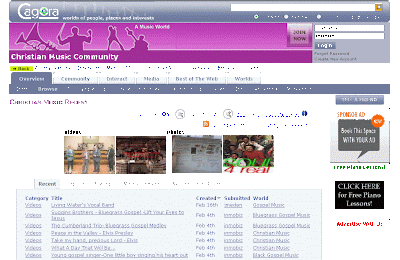
Founded by Rob Anderson, Community Enabler, trading under the banner of Cagora.com which is the flagship website, is a project tentatively called the Social Networking Challenge which will launch in March 2008. It is a Social Enterprise that is setting out to do its bit to make the world a better place by fostering Community Building and empowering Business Entrepreneurs and Social Entrepreneurs to achieve their goals.

It is run as a for Profit Business, but will be launching Not For Profit initiatives such as The Social Networking Challenge which is designed to create a word-of-mouth Tipping Point harnessing the viral connectivity of the Blogosphere and the major Social Networks such as Faceboook and MySpace.

Rob describes the service in his words:

It has a shortcut way for people to browse and search the Social Networks for People and Groups. The same interface to enable people to browse on one page thousands of Bloggers, Podcasters and Videocasters.

People register free, Grab a Free Square on our 'Browse Boards' which will be a series of mosaics boards of photos and logos so that on one page there are thousands of Melbourne Facebookers or on one page thousands of MySpace Automotive Groups or on
one page thousands of Australian Blogs

We then sell advertising at the top of the Boards with at least 90% of the proceeds going to Charities as voted for by the participants.

By inviting your friends who join you will increase your chances of winning prizes donated by businesses in exchange for exposure.

People will also be able to participate in our Cagora Community Network that takes Social and Business Networking to the next level with Community Networking and Community Media.

We call it Community Networking because it's not about sharing Saturday night's party photos but rather about collaborative Local and Special Interest Communities. We have one community per topic, not hundreds of disparate groups.

Cagora is the world's first comprehensive network of over 20,000 Local and Special Interest Communities where you can meet and network with like minded people and create, share and browse interesting content like Videos, Photos, Blogs, Articles, Reviews and Polls. Each community whether it be Stonnington in Melbourne or Rock Climbing or Quilting is a one stop spot to the Best of the Web.

We've developed an Open Source Community Networking and Media platform that is rather like a cross between Facebook, YouTube, Wikipedia, Yellow Pages and Google where the wisdom of the crowd enables people to easily find what they are looking for.

To date none of the big players have been able to engage the Small Business and Non Profit sector in a way that results in millions of organizations around the world providing detailed information into a comprehensive Yellow Pages style directory. With the exception of Google they have not been able to get these businesses to open their wallets to pay for advertising in large numbers.

We have developed a blueprint to do this by creating win-win within communities.
Let us learn more about Rob and Community Enabler :

Who are the founders
Rob Anderson had 15 years experience in the manufacturing sector, initially as a Chemical Engineer and then subsequently in Operations and QA Management roles as well as a freelance Management Consultant. In 2000, I sawthe opportunity to use the Internet to create Social Good whilst making it easier for people to find things online using Search Communities and the
wisdom of the crowd.

How long did it take
When we missed out on VC funding around the time of the Dot Com crash in 2000 I then started other online businesses and did Management Consulting work waiting for the market opportunity to emerge. Over the past 4 years we've been developing our Community Platform and only recently launched the Cagora network. Our main growth project: The Challenge is still to launch.

Project Status
Stealth mode with The Challenge and early Beta with the Cagora Network

Main Objective
Make the world a better place by fostering Community Building and empowering Business Entrepreneurs and Social Entrepreneurs to achieve their goals. We aim to make a significant contribution to solving the Information Overload problem.

Services
Mainly free services
Social Networking, Social Media and eLearning but we also offer paid advertising and information products

Unique Selling Proposition
The first one stop network of online communities within a structure of single local and special interest communities. We share our revenue with our members through our free affiliate
program and our Community Partner program, and also distribute 80% of what a company would retain as profits, with our members and member chosen charities and community groups. There are no fees to pay to receive affiliate commissions or participate in our 80% Bonus Pools.

Market Info
We target all B2C and B2B verticals. Our demographic target audience is men and women internationally between 14 and 114 years of age

User Numbers
We currently only have 40,000 members but expect to have more than 5 million within the next ten weeks

Word Of Mouth
our free affiliate program and The Challenge is how we expect to attract strong word of mouth, along with the PR aspects because of how we are generating revenue for the Non Profit Sector.
PR is expected to be the main marketing channel. We will also have some paid advertising budget and in longer term expect big impacts as our Communities achieve authority status within Google.


Measuring Indicators
Sales and total registrations gives us a good indicator of business success

Monetization
  • Online and Offline advertising
  • Info products
  • Communication products
  • Affiliate revenue from 3rd party products
  • Also we may introduce premium membership benefits
Competitors
Facebook, Sensis (locally) Google, Yahoo

Technologies
Our own Community Commerce platform built upon the Drupal Open Source Content Management system (php MySql)

Networking
We do significant online networking and also participate in
Entrpreneur Meetup.com groups here in Melbourne

Investment
100,000s of manhours and about $500,000 in cash

Australian Barriers for Startups
We found venture and nngel money very difficult to come by for an ambitious business model. Also not as strong a mentor base as in USA.

Future Trends
  1. We believe the world is currently undergoing a Social Revolution which will have far more reaching impact than the Industrial, Information and Communications revolutions that preceded it. The Social revolution is not just about web 2.0 and consumer power, but rather a shift to re-assessing the importance of social values in society.
  2. We believe you will see more and more Social Enterprises that are not primarily driven by profits, but rather social impact that will see the emergence of FREE as a new business model that makes things tough for many capitalists.
  3. We believe the re-emergence of Community will be a key aspect of these changes.

Advice
Make sure you are convinced you a the stomach to see things through and that you get the buy in from family in particular your spouse. Also focus on generating cash flows early to sustain things should you find it takes longer to get your business going, and in the process minimize overheads until you are over the hump.

Thanks Rob for sharing your thoughts. We look forward to hear from you in future on the progress of Community Enabler. All the best for Community Enabler and the competition in this carnival.

Continue Reading >>

ZaaBiz

Vishal Sharma Monday, March 10, 2008 , , , , , , , 1 comments

The 18th participant is ZaaBiz
ZaaBiz - is an online social networking site for professionals. It connect’s Australian’s in business with other professionals in Australia and beyond. Michael Brecht is the founder and CEO of ZaaBiz. Michael has lived in Australia for four years and saw a niche for an online social network that was geared towards Australians.

Let us explore bit further about ZaaBiz. We asked few questions and this is what Michael has to say:

Q. How long before it was up and running?
A. 6 months

Q.What stage is your company at?
A. Fully- functioning networking site for professionals.

Q. What is the main objective behind your venture?
A. The main objective is to be the leading & profitable social networking platform for business professionals in Australia and beyond.

Q. What services does it provide for customers/ consumers?
A. Groups, Forums, Articles, Newsletters, Advanced Search & Power Search, finding new business connections and more Web 2.0 applications under development

Q. What is unique about your venture?
A. It is Australian based in an effort to provide a user-friendly and effective networking tool for Australians and those wanting to connect with Australian business people. It is unique in showing all connections to a particular contact; some are 6 degrees or less. Most platforms do not show all the connections. Premium members can send messages to other members they may not be connected to. This potentially opens up many new business opportunities.

Q. What market segment verticals are you targeting for?
A. We are not targeting a specific market segment vertically, instead all professional business people. Our existing membership base shows a high percentage being small & medium sized business owners.

Q. What type of customers are you targeting?
A. Our target market is business professionals aged between 20 and 55 years. Small business owners and entrepreneurs are high on our target list.

Q. What age group of people will be benefited most?
A. Business professionals between the ages of 20 and 55 will see the most benefit.

Q. How many users are using your services?
A. ZaaBiz has several thousand users, with the majority from Australia.

Q. What sort of marketing are you using to spread the word?
A. SEO, SEM (Google Ads, Blogs, Invitations, Events), Online Partnerships, Affiliate Programs, Media

Q. How are you measuring the success of your venture? Are there any special tools in place to monitor the progress?
A. ZaaBiz is managed by experienced business professionals who have grown, lead & managed several businesses of a similar type before. We have a monitoring & benchmarking tool set in place which is updated on a monthly basis.

Q. What is the monetizing/revenue model? Is there a new model which is being trialled?
A. Premium membership fees and Group Sponsoring fees. Premium members pay monthly, quarterly or yearly fees. Premium Groups are sponsored by corporations and associations alike.

Q. Which are the main competitors or major players in this market segment?
A. LinkedIn from USA, however they are not really focussed on the Australian market place.

Q. What are the main technologies used behind this start-up?
A. Webserver, Database, PHP

Q. Are you using a lot of open source tool sets for this?
A. Apache, PHP, MySQL, Linux

Q. What is your operating environment (OS) and what type of database are you using?
A. Linux, MySQL

Q. How often do you catch up with others trying similar things and where do you catch up?
A. Weekly, through networking events and online forums

Q. How much money is needed upfront to start a venture?
A. Less than $1 million

Q. What are the main barriers in general for people starting their venture in Australia?
A.

  • Need to be near a big city to generate capital backing.
  • The remoteness of Australia in a global market place.
  • Broadband availability in rural Australia.
Q. What are your thoughts on future trends of your service and market segment you are in?
A. Business networks are ever-growing and still an underdeveloped market.

Q. Do you have any advice for people who want to start their venture?
A. Plan your infrastructure and outsource help where you need it. Plus have enough capital behind you because your business may not grow as fast as you need it to.

Thanks Michael for sharing your thoughts. We look forward to hear from you in future on the progress of ZaaBiz. All the best for ZaaBiz and the competition in this carnival.

Continue Reading >>

Rave About It

Vishal Sharma Monday, March 10, 2008 , , , , , , , 2 comments

The 17th participant is Rave About It

Rave About It, launched in beta mode in November in 2006, aims to provide an enjoyable way in which users can search, rate and discuss what they think of services in their local area and beyond. It is like word of mouth, but online, as this is the most accurate representation of how well a business services their customers. In addition to helping businesses make themselves heard through real testimonials, small businesses are able to market themselves through other features that the site offers.

The concept of Rave About It was first discussed between Mark Rimmer and Tim Griffin in June 2006 at a friend's birthday party in Sydney. It was an idea that Mark had suggested, initially because he was on the search for a recommended local hairdresser. They have refined the idea to support in-depth reviews of any type of business - products and services that were physically, mobile or Internet based. Subsequent research revealed that a strong business review scene was already developing in the States, with the trio of business review websites, Yelp, Insider Pages & Judy's Book being most prominent. Whilst they liked these sites, they wanted to design something with an Australian focus.

Let us explore bit further on different facets of Rave About it from Mark. We were the first business review website in Australia to offer business reviews across all industries and all States in Australia.

Q. How long it took before it was up and running?
A. It took us 3 months to get an alpha version up and running, followed by another month of testing and refinement based on user feedback to reach a beta version

Q. What stage of your start-up is, stealth mode, beta mode or fully functional?
A. Fully functional / Perpetual beta ;)

Q. What is the main objective/mission behind your venture?
A. Become the most prominent business review website and become synonymous with reviewing technology in Australia.

Q. What services it provides it for consumer or customers?
A. Rave About It aims to serve two needs:

  • Provide the consumer an environment in which they can search and review any business in Australia
  • Provide a business owner the ability to benefit from word-of-mouth feedback, as well as tools to market their own products and services.
Q. What is unique about your venture?
A.
  • In July 2007, we outsourced our reviewing platform to a major on-line business directory in Australia and are currently the only reviewing platform to do this in Australia.
  • Most business review websites are focused heavily towards the consumer - we provide an environment that takes care of a business's needs as well through a complete business profile, that includes features comparable to a premium listing in major on-line business directories
  • We fully support open standards and our reviews are indexed by major search engines and can be viewed in Google Maps through our RSS capabilities, for example.
  • Every business sub-category in our database has a set of reviewing criteria unique to that industry. For example, a Gym may be reviewed based on its 'cleanliness', or a mechanic may be reviewed, based on their 'workmanship'
  • We display both positive and negative reviews - we feel that business owners learn most when they can receive honest feedback from both happy & not so happy customers.
Q. What market segment verticals you are targeting for?
A. All industries, however the majority of traffic that we are receiving relates to the Hair and Beauty Salon industry. In terms of customer feedback, these are two industries that were previously poorly presented in Australia prior to Rave About It - we found that the majority of this feedback was in the form of an unstructured forum or blog post.

Q. What type of customers you are targeting?
A. From a consumer perspective, Men and Women in the 20 - 50 y.o. age bracket.
From a business perspective, any small to medium size business

Q. How many users are using your services?
A.
  • Number of uniques per month: 50,000
  • Number of users: 1,300
  • Number of accounts: 1,300
Q. What sort of marketing you are using to spread the word?
A. Search engines optimisation mainly - 90% of our daily visitors are new to the site and the majority reach our site through search engines.

Q. How are you measuring the success of your venture? Are their any special mechanisms/tools are in place to monitor the progress?
A. We are looking at the following metrics, using a combination of Google Analytics and site logs.
General
Is the site receiving an increasing amount of relevant traffic?
Consumer:
  • Is the quantity of reviews increasing?
  • Is the quantity of pageviews per users increasing?
  • Are we seeing an increase in the number of returning reviewers?
Businesses
  • Is the number of businesses being listed increasing?
  • Are those business profiles receiving decent exposure in the search engines?

Q. What is the monetizing/revenue model? Is their any new model, which is being tried?
A. The site currently receives some revenue through a combination of Google Advertising and banner advertising.
We have developed a fully functional, scalable reviewing platform that can be outsourced to any large website that wishes to incorporate reviewing functionality into their service. This reviewing platform can be seen live at http://www.dlook.com.au
We are currently trialing a beta program for a paid service, RaveLeads that generates leads for small businesses through promotion on the Internet

Q. Which are the main competitors or major players in this market segment?
A.
Competitors:

Privately-owned
Public
  • Nook
  • Truelocal ( Not a 'pure' business review website, due to the lack of reviewer profiles etc and the fact that it is primarily a business directory, however it has the potential to drive the business review industry due to its weight in the local search arena in general.
  • Sensis
  • Nearme
For a in-depth discussion of the local business review scene in Australia, please see here

Q.What has been the most easy to use, out of box and helpful technology?
A. We use Google products extensively: Google Maps API, Adsense, Analytics, Webmaster and Adwords

Q. Are you using lot of open source tool sets for this?
A. Entirely open source.

Q. What is your operating environment (operating system) and what type of database you are using?
A. Linux, Apache, PHP, MySQL

Q. How often do you catch up with others trying similar things and where do you catch up. Do you have dedicated communities in your city?
A. Approximately once a month in person. Regular events in Sydney we attend include STIRR, BarCamp, WebJam, Beer 2.0

Q. How much money is needed upfront to start a venture?
A. Our budget (up to beta launch) - approx $4k
Breakdown:
  • Business name registration and company setup : $1,500
  • Domain name registration (including .com.au and .com domains): $200
  • Hosting: $100
  • Business Cards: $200
  • Graphic design (layout and logos): $850
  • Hardware, software etc: $1,000
Q. What are the main barriers in general for people start their venture in Australia?
A. Although it was never an issue for Tim and me, since we were close friends to begin with, finding the right person to start up a company with can be extremely difficult. While it is possible to work on a start-up by yourself, inevitably there will be tough times, where you don't have that support that you would have, if you had a business partner.

In the past 12 months, the number of tech/startup events has grown rapidly in Sydney and with the take-off of Social Networking, it is easier for local people to get together and network.
In some cases, individuals I have spoken to at tech events felt like they did not have the relevant skills to create a successful start-up, e.g. a web developer with no business experience, or a business-minded person with no programming skills.
Such hurdles can be overcome by partnering with someone that has complimentary skills to your own. Such was the case with Tim and myself, when we started Rave About It.

Q. What are your thoughts on the future trends of your service and market segment you are in?
A. Australia as a Reviewing Nation
Outside the scope of restaurant/cafe reviews, structured on-line business reviews are a relatively recent activity in Australia. It has been commented by Australian bloggers that Australians, as a whole, are more reluctant to voice their opinions on-line than say internet users in the US. In the US, users of sites like Yelp provide in-depth, passionate reviews about businesses that they are reviewing, whereas Australian reviews tend to be more straight-to-the point summaries of user experiences. We feel that Australian reviewers will behave more like their US counterparts as they get more used to writing and reading reviews. Similarly, we feel businesses will also become accustomed to being rated publicly.

Fragmentation
The amount of reviewing type websites in Australia is growing, but with each additional website, the market becomes increasingly more fragmented. This is so as the majority of websites do not as yet support open formats such as RSS based Microformats (hCard/hReview) and GeoRSS (location-encoded RSS feeds).
Due to the lack of open formats implemented on these sites, the collaboration of user reviews is limited, so this restricts the ability for Search engines or other sites to aggregate reviews in a meaningful manner.

Legal Environment
In Australia defamation law differs to the US in that in Australia lacks a Bill of Rights, which protects Freedom of Speech.

To date, there are several defamation cases that have taken place relatively recently in Australia. The first case involves a Sydney Morning Herald food critic describing a negative experience he had in a restaurant in Sydney (John Fairfax Publications v Gacic). The restaurant's proprietors sued Fairfax seeking damages for business defamation in a case that is currently ongoing

The second case (2Clix vs Whirlpool) , resulted in accounting software firm 2Clix has suing the founder of Whirlpool, seeking damages of $150,000 and the permanent removal of two threads on the site discussing the company's products. 2Clix ultimately dropped legal action against Whirlpool, however the outcome of the case, should it have gone to court, would have had massive implications on the use of Internet forums in Australia.

The above cases indicate that any local business review website in Australia, negative reviews need to be managed extremely carefully, In the US, the leading online business review website, Yelp, has such an influence in San Francisco that it can make or break a business in a matter of weeks.

Q. Do you have any advice for people who want to start their venture?
A.
  • Consider your business model from day one - the majority of start-ups in Australia are not VC-backed, therefore you'll need to fund it out of your day job or savings.
  • Consider government grants as a source of early funding.
  • Get involved in the local start-up community. In addition to providing invaluable advice, you'll meet like-minded people and through networking, open a lot of doors.
  • If you're first attempt doesn't work, keep trying. Most people give up after their first major hiccup - if you can make it through that phase, then you'll become even more determined to succeed.
  • Maintain as regular communication with your business partner as possible. Aim to meet up in person at least once a week to plan ahead and go over the venture in general. Tim and I chat multiple times a day on the Internet - the benefit is that all your chats are logged, so you can go back to extract discussions later.
  • New ideas are great, but don't get distracted from the core focus on your venture, and in particular, your strengths as an individual.
  • Focus on your strengths and don't dwell on your weaknesses. Several times, when there was a backlog of coding work to be done, I contemplated learning how to code, so I could assist Tim - thankfully I talked myself out of it - I would have been a hindrance, not a help!
  • If you can't contribute to a single line of code, don't despair - there are plenty of ways that you can contribute your equal share of work. These include focusing on sales, business planning, marketing, writing site content, testing, and finance, to name a few areas.
Thanks Mark for sharing your thoughts. We look forward to hear you in the future on the progress of Rave About It. All the best for Rave About It and the competition in this carnival.

Continue Reading >>

Vquence

Vishal Sharma Sunday, March 09, 2008 , , , , , , 0 comments

The 15th participant is Vquence
Vquence is an Australian startup in online video technology. Vquence's business is in Social and Online Video aggregation and metrics. Vquence's experts have more than 10 years experience with new video technology and applications for the Web, as well as an extensive background in data mining and high availability server infrastructure.

The company was founded by veteran entrepreneur Chris Gilbey, former CEO of Lake Technologies, and Dr Silvia Pfeiffer, former Multimedia Science Leader at the CSIRO ICT Centre in July 2006 with funding from ICA (Information City Australia). The funding was used to develop new technology in video search from scratch and prepare a business plan with which to acquire further funding to build a consumer Web service.

Let us learn more about Vquence from one of the founders Dr Silvia:

Q. How long it took before it was up and running?
A. The discussions to prepare this startup had been going for close to a year before Silvia was ready to take the plunge from CSIRO and team up with Chris to use the offered capital to develop a new business. To facilitate the transition, CSIRO allowed Silvia to go on 6 months leave-without-pay for the second half of 2006 and an option to return to CSIRO should the business fail. In January 2007 Silvia left CSIRO for good.

Q. What stage is your startup in - stealth mode, beta mode, or fully functional?
A. Vquence is offering three different services to business customers:

  • VQdata - a webservice for indexing the online social video space
  • VQslices - embeddable widgets for the management of video collections
  • VQmetrics - quantitative metrics and analytics of online video
VQdata and VQslices are fully functional services, while the VQmetrics service is in stealth mode. The consumer service is in beta mode.

Q. What is the main objective/mission behind your venture?
A. Our mission is to enable people and enterprises to master a world of unlimited online video choices.

Q. What services it provides for consumer or customers?
A. Vquence provides consulting and technology services for online video publication, aggregation, and metrics to corporate customers. We deliver these services through so-called widgets, which are web-based modules (essentially iframes) that can be re-used by clients on their own Web site.
Vquence has also developed a consumer-facing website which allows consumers to search for online published videos across a multitude of different sites through one interface. It further allows consumers to create sequences of such videos, e.g. about a particular topic of interest, and enables them to re-publish these sequences in their blogs or on their websites. These video sequences are called "vquences" and provide dense video publication, comparable to what table of contents do for text. Vquences can also be used inside Facebook to share collections of videos rather than just a single one.

Q. What is unique about your venture?
A. Vquence provides a comprehensive and unique set of tools to master the social video space. We have developed an online video search and aggregation service that is flow-based rather than following the traditional crawling principle of Web search engines like Google and
Yahoo. Our flow-based search is based on RSS feeds and Vquence-proprietary search techniques and thus the pitfalls of crawling-based search engines that cannot provide new information at
real-time.
Vquence also has patented social video analytics algorithms which provide metrics that are not available through any other source.

Q. What market segment verticals are you targeting?
A. The Vquence business services target small and large companies in the online media space.
Media intelligence companies come to us to gain information and data feeds about social video and its spread using the VQdata service. Advertising companies come to us to monitor the audience and the spread of viral video campaigns using the VQmetrics service. And new media companies come to us to gain video publishing and search services for their Websites using the VQslices service.

The Vquence consumer service is targeting people that publish video content on the Web. These are mainly the blogger community and news sites, but are also attractive to educational sites and other video-interested sites.

Q. What age group of people will be benefited most?
A. The consumer service is not inherently targeted at an age group.

Q. How many users are using your services?
A. Vquence has a handful of business customers. There are 122 subscribed users. The video search on the site does not require you to log on, so there are quite a few more anonymous users.

Q. What sort of marketing are you using to spread the word?
A. At this point in time, we are only using blogs and personal communication to spread the word about . There are more features that we intend to develop before the site becomes fully functional. At that time we will want to go for a full online marketing campaign, which includes spreading the word in online fora, banner ads, Google ads, and possibly on the radio.

Q. How are you measuring the success of your venture? Are there any special mechanisms/tools in place to monitor the progress?
A. We measure the success of Vquence through the number of contracts that we have with customers and through the number of subscribers we have to the consumer Website. We further measure the success that vquences have for our customers through user interactions that we are capturing through our vquence player.

Q. What is the monetising/revenue model? Is there any new model which is being tried?
A. Our monetisation model for the corporate site is based on an ISP-like model. Our services incur a setup fee and a monthly service charge. The service charge is based on volume of use.

The consumer site is monetised through contextually chosen Google ads for the vquences. However, we have some further ideas for monetisation that are based on including video ads into the vquences chosen by relevance to the videos in the sequence. This will work especially well
with the search service. So far, there is no video advertising agency that can provide a collection of short and succinct video ads that would fit inside vquences and can be chosen contextually, i.e. there are no Google video ads to choose from.

Q. Which are the main competitors or major players in this market segment?
A. The VQmetrics service is providing services to customers in Australia that are similar to services that the US startups TubeMogul, VidMetrix and VisibleMeasures are developing. We also expect that major players in the Web metrics market such as Hitwise, Omniture, or Doubleclick will want to enter the video analytics space in the near future.

Q. What are the main technologies used behind this startup?
A. We use Java to build our search technology, Lucene to do the indexing, MySQL as the database backend, and Ruby on Rails with AJAX and XML technology for the Web front-end and the delivery of widgets. For development management purposes we use bazar as the open source code management system and trac as the developer wiki and bug tracker. In addition, we use joomla for the company website.

Q. What has been the most easy to use, out of box and helpful technology?
A. All of the open source tools that we use, in particular MySQL and Lucene, are most helpful.

Q. Are you using a lot of open source tool sets for this?
A. Yes, we use open source tools where we can because they are usually of very high quality and can be adapted to our needs. Also a positive side-effect is that they come for free.

Q. What is your operating environment (operating system) and what type of database are you using?
A. Our operating environment for our servers is Linux - or more specifically we use Ubuntu where we can. We run some of our code on Amazon services EC2 and S3, but also have dedicated servers in the US on which we partially run Xen. The database system that we use is MySQL.

Q. How often do you catch up with others trying similar things and where do you catch up? Do you have dedicated communities in your city?
A. We frequently catch up with people that work on and with the open source tools that we use. This happens both online through irc, email, bug trackers and similar tools, as well as in person. We are part of the Sydney Linux User Group SLUG, members of Linux Australia, and also
occasionally attend the Ruby on Rails Oceania meetings.

Q. How much money is needed upfront to start a venture?
A. That depends very strongly on the type of business you are starting. In the online space, you may not need much. If you start with, say, three people, two of which are coders and one is a marketing/business person, and you have the regular income for the three people sorted, the extra expense for starting an online website can be as small as a few hundred dollars a month using Amazon EC2 and S3. However, this depends on the type of service you are starting. Ours requires that we store a lot of video and do a lot of processing, thus we require a more decent
infrastructure.
BTW: check out this blog post that contains some real numbers of expenditure of the two first years of a startup in the US

Q. What are the main barriers in general for people to start their venture in Australia?
A. Australia is a fairly small market. Thus, your business will find it very difficult to grow if it is just Australia-focused.

To build a globally competitive online business from Australia is very hard - you don't have the same business networks, the same investment networks, and the same quality communication networks in Australia as you get in the US.

Australian captial does not typically sponsor online businesses, but rather flows into mining, health, and agricultural businesses, which are deemed less risky.

Also, because Australia is so small, finding talented people in Australia can be very hard if you have a specific need.

Q. What are your thoughts on the future trends of your service and market segment you are in?
A. Our market segment is currently still in its infancy and will be growing strongly in the near future. This is because people are starting to realise the power that online video holds in bringing a message across to the audience. Not only is it an on-demand viewing style, but the typical online audience is a social network, which share their experiences with their friends. Thus, online video provides a powerful means of viral marketing that has never been available before in the same manner. This marketing potential is in the process of being uncovered and exploited. To prove the impact of such marketing campaigns, we will require very detailed metrics.

Therefore we can see the field of online video aggregation and metrics grow in a massive way in the near future.

Q. Do you have any advice for people who want to start their venture?
A. Have a very clear picture of what you want to achieve first and who the people are that will be your clients before you start. Then start with all your energy and don't let yourself get distracted by critical bystanders. However, be flexible to adapt your business to the actual needs of your clients as you uncover them - your first shot will hardly ever hit the bullseye.

Thanks Dr. Silvia for sharing your thoughts. We look forward to hear from you in future on the progress of Vquence. All the best for Vquence and the competition in this carnival.

Continue Reading >>

Applebox - Sunday Surprise

Vishal Sharma Sunday, March 09, 2008 , , , , , , 0 comments

We had few late entries for the registration, most of them made it into the final list but few missed out. So we thought let us cover them as a surprise package. These entries are not eligible for participating in competition. So today's surprise entry is APPLEBOX .
Startup, Australia, Consulting, Venture
APPLEBOX is the easiest way to rent DVDs ever. It operate as a local store giving customers immediate access to find and watch DVDs as they always have, but our entire catalogue is online which means as well as browsing in-store, customers can browse and make selections from home or work as well. It has dramatically reduced the barn-like size of a Video Ezy to a small comfortable space without the racks and shelving.
All the stocks are held in high-density, behind-the-counter storage, and when customers find and select a movie our system allocates an available disc to them. The selected item is available for them to pickup by the end of the day. Search, book, pickup ... simple. The system operates in realtime, so if a movie is unavailable the storefront will place a red Out banner over the cover art.

This is created by sole founder Simon Gilligan. He describes:

Customers no longer need to walk along 50+ meters of racking to find a movie; Browsing is intelligent (by genre/actor/director) and with hi-res cover art (so there's no squinting at thumbnail images); Families/Couples/Friends can all a choose movie to watch from home without arguments and calls from the video shop 'Have you seen this?'; Our in-store experience has finally broken the 80's mold of a local video store and it looks and feels great!

Our reduced floor space (30sqm vs a typical 160+sqm) means lower fixed overheads, our high-density storage means greater stock carrying potential, and intelligent search gives new visibility to the long tail which is otherwise untapped within the traditional video store. Member activity is moved online and members are seeded into a community that will span all APPLEBOX stores and grow as new stores are added to the group. Members will also be able to rent movies across all stores giving them future access to a library unrivaled in size by any competitor.

Simon gives more insights to us on his startup.
Q. How it started?
A. I had the idea of moving the local video store online over 5 years ago. It seemed like a logical evolution, but a step that none of the major chains had experimented with. Industry discussion about the future of home entertainment continued down the lines of Video on Demand (VOD) and mail order, but still no insight into how the local store (still the backbone of the industry) could be improved. 3 years ago I wrote a business plan to crystalise ideas and messed about with a prototype storefront. Still no-one had innovated with the local store, no-one had tried this model, and by most reckonings, if it hasn't been done before its a dud idea! Yet, with a mixed future of DVD rental and VOD coming down the line, it seemed to me the opportunity was strong to unseat traditional video stores as their margins become squeezed over time. APPLEBOX with its significantly lower overheads could grow as a viable offline delivery business in spite of the mature stage of the market, and slowly contracting revenues. Importantly, by moving members online, APPLEBOX could create a strong social community and still be in the game for future online developments.

Rather than sell the concept (and pick up the development) to Video Ezy/Blockbuster, I decided to boostrap the business myself, create a flagship store and take it from there. I quit my day job and went onto APPLEBOX fulltime.

Q. How long it took before it was up and running?
A. 2.5 years from committing full time to the project to the doors opening on my first store in September '07 (currently the only store). 2+ years of software development is quite scary, and totally against the web 2.0 mantra of bang something together quickly, get it out there and improve quickly. However for APPLEBOX to function it needed its own content management system, storefront catalogue, membership system, finance platform and operational data feeds. Plus time was spent putting together an application platform that I now re-use on other projects and consulting gigs.

Q. What stage of your start-up is, stealth mode, beta mode or fully functional?
A. Fully functional.

Q. What is the main objective/mission behind your venture?
A. Make APPLEBOX the easiest way to rent DVDs ever! I want to generate real competition for Video Ezy, so the advantages and service APPLEBOX delivers must be compelling.

Q. What services it provides for consumer or customers?
A. DVD rental

Q. What is unique about your venture?
A. New convenience to renting DVDs locally. Customers can rent online (from home or work), yet the pickup can be immediate. Traditional video stores (eg Video Ezy) don't offer this convenience, and mail-order models (eg Quickflix) impose delayed delivery times that make spontaneous renting impossible.

Q. What market segment verticals you are targeting for?
A. home entertainment, DVD rental

Q. What type of customers you are targeting?
A. All movie renters, but primarly those that are net savvy with broadband connections.

Q. What age group of people will be benefited most?
A. All ages. We have reduced mobility pensioners who love APPLEBOX because they don't have to shuffle around a large